
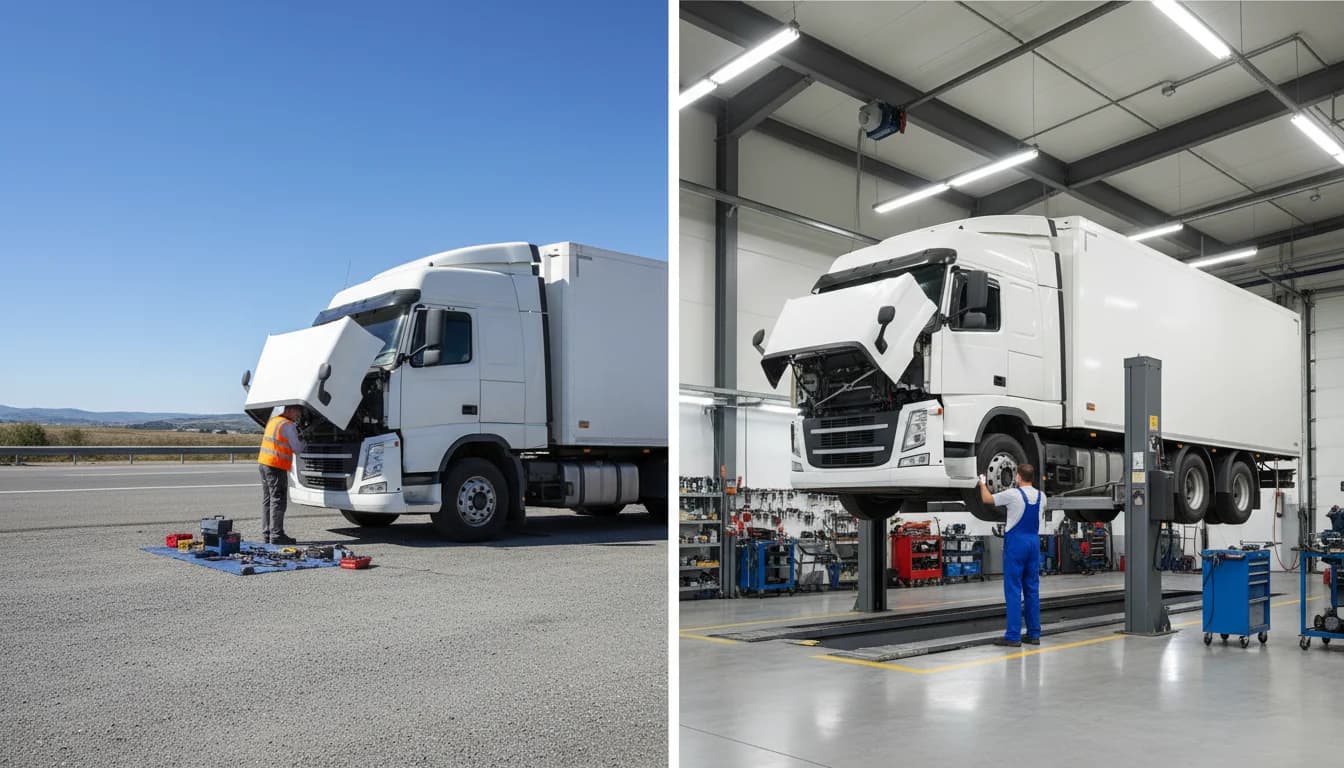
The debate between mobile diesel repair and traditional shop repair isn't really a debate at all — both have their place. The question isn't which is better, but which is better for this specific repair in this specific situation.
Here's a practical guide to help truckers, fleet managers, and owner-operators make the right call.
When Mobile Repair Wins
Mobile diesel repair is the clear choice in these scenarios:
Emergency Breakdowns When your truck is on the side of I-75 at 2 AM, mobile is the only option that doesn't involve a tow truck. Towing a loaded Class 8 truck costs $500-2,000+ depending on distance, and then you still need to wait for a shop bay.
Mobile mechanics come to you, diagnose on-site, and complete the repair where the truck sits. Total cost is almost always less than tow + shop repair.
Fleet Yard Maintenance If you have 20 trucks in your yard that need PMs, brake inspections, or DOT annual inspections, why would you drive them one at a time to a shop? A mobile mechanic comes to your yard and services them where they're parked.
The math: 20 trucks × 30 minutes of drive time to a shop × driver hourly cost = a lot of wasted money. Mobile service at your yard eliminates that completely.
Simple to Moderate Repairs The majority of diesel repairs can be completed in the field: - Brake jobs - Filter changes and fluid service - Belt and hose replacement - Sensor replacement - Battery and electrical service - Air leak repair - DPF forced regens - Starter and alternator replacement - Minor hydraulic hose repair
These repairs don't require shop equipment and can be completed with the tools a mobile mechanic carries.
Time-Sensitive Situations When you have a perishable load, a delivery deadline, or a driver running out of hours, speed matters more than anything. Mobile repair eliminates the time wasted on towing, shop queues, and driving to/from a facility.
Remote Locations Construction sites, farms, oil fields, and rural breakdown locations are often far from any qualified diesel shop. Mobile mechanics are built for these situations.
When Shop Repair Makes Sense
There are legitimate situations where a shop is the better choice:
Major Engine Work An in-frame engine rebuild, cylinder head machining, or crankshaft work requires shop equipment — a crane, machine shop tools, and a clean environment. While mobile mechanics can diagnose and perform some top-end work in the field, major internal engine repairs belong in a shop.
Transmission Overhaul Pulling and rebuilding a transmission requires a floor jack capable of supporting it, a clean workspace, and often specialized press equipment. This is shop work.
Frame and Alignment Work Frame straightening and precision alignment require fixed equipment — alignment racks, laser measurement systems, and frame machines that can't be transported.
Extensive Welding or Fabrication While mobile mechanics carry basic welding equipment, extensive frame repairs, structural welding, or custom fabrication work is better suited to a shop with a full welding bay, metal stock, and fabrication tools.
Painting and Body Work Cab repair, panel replacement, and refinishing require a paint booth and body shop equipment.
The Hybrid Approach
Smart fleet managers use both mobile and shop service strategically:
Mobile for:
- All emergency breakdowns and roadside repairs
- Scheduled preventive maintenance at the yard
- DOT inspections at your facility
- Quick-turn repairs (brakes, electrical, filters)
- Diagnosis — let a mobile mechanic figure out what's wrong before you commit to a shop
Shop for:
- Major powertrain work (engine rebuild, transmission overhaul)
- Warranty repairs that require dealership facilities
- Frame and alignment service
- Body and paint work
- Repairs that will take multiple days with the truck indoors
Cost Comparison
Let's compare a common repair — a brake job on a drive axle — to illustrate the true cost difference:
Shop Route - Tow to shop: $500 (if breakdown) or drive time: 1 hour - Shop labor: 3 hours × $150/hour = $450 - Parts: same either way - Return trip: 1 hour of driver time - Total extra cost beyond parts: $950+ and 5+ hours of downtime
Mobile Route - Mobile mechanic arrives on-site: 30 minutes - Labor: 3 hours × $145/hour = $435 - Parts: same either way - No tow, no return trip - Total extra cost beyond parts: $435 and 3.5 hours of downtime
The mobile option saves $500+ and 1.5+ hours on a single brake job. Multiply that across a fleet and the savings are substantial.
Questions to Ask Yourself
When deciding between mobile and shop, ask:
1. Can this repair be completed with portable tools? If yes → mobile 2. Does this require shop-only equipment? If yes → shop 3. Is time critical? If yes → mobile (even if a shop could do it, the tow and queue time may not be acceptable) 4. Is my truck drivable? If no → mobile (unless you need a tow anyway for shop-only work) 5. Is this warranty work? If yes → check with the dealership. Some warranty work must be performed at an authorized facility.
The Bottom Line
Mobile diesel repair isn't a replacement for shops — it's a complement. The best approach uses mobile service for the 80% of repairs that can be done in the field and reserves shop visits for the 20% that genuinely require fixed equipment.
If you've been defaulting to shop visits for every repair, you're probably spending more money and losing more uptime than you need to. A good mobile diesel service handles the majority of your repair needs faster, cheaper, and with less disruption to your operation.